In this article:
- AI Revolution Across Sectors
- Organizational Opportunities and Concerns about AI
- Human-Centred Approach to AI Adoption
- Thoughtful Change is Good for Business
AI Revolution Across Sectors
There is no denying it, an AI revolution is underway. I find the advancements for science and the use of AI in medicine extremely promising for the future. In my world, Adobe Acrobat Reader introduced “AI Assistant” that will summarize an article for you; the Project Management Institute (PMI) launched “Infinity” a support tool for project managers; and I’m using generative AI tools for qualitative research. Recently, StatsCan noted in Q1 2024 that “one in seven Canadian businesses were already using (9.3%) or had plans to use (4.6%) generative AI.”
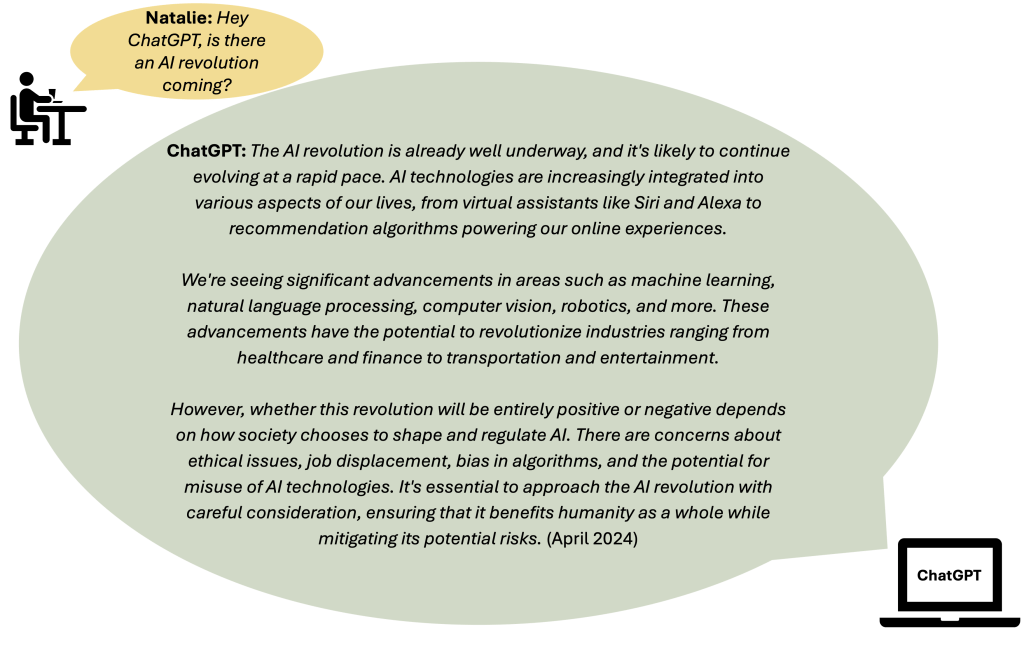
“It’s essential to approach the AI revolution with careful consideration, ensuring that it benefits humanity as a whole while mitigating its potential risks.”
– ChatGPT 3.5 April 2024
As an anthropologist and change leader, what I am most interested in is how we design AI, how we use AI, and who it impacts. The fact that ChatGPT is well aware of the potential risks of AI tells me the global sources of data it draws this conclusion from are also concerned. Therefore, we should be thoughtful about AI’s adoption and use. Your organizational decisions about AI impacting humanity as a whole? It may seem hyperbolic. But the actions of every individual, and every organization are nested within industry, interconnected systems, and nature itself. We know, for example, that our personal choices can shape the impacts of climate change around the globe. Similarly, how we integrate AI into our lives and the data we use can impact (and influence) other people and communities. Considering the externalities of AI, or unintended benefits and impact, requires us to ask questions about the sources of data and how the data will be used (Acemouglu 2021; Christian 2021; Hagendorff 2022).
Organizational Opportunities and Concerns about AI
Organizations are learning about AI as they go. Besides the opportunity for productivity gains, there are new job skills possible, and new positions we haven’t dreamed of yet – consider the emergence of the “webmaster” after the adoption of the internet. As well, the opportunity for generative AI to augment the work of knowledge workers with efficient data analysis provides incredible opportunities for idea generation and innovation. From taking notes, creating data visualizations and novel images, the ways AI will enable our work is exciting. Repeatable operational tasks can be replaced with AI while creating space for more complex or strategic work we never have the time for.
Besides the opportunity for the use of AI in organizations, I see an equal amount of uncertainty, even concern. For instance, organizations will implement AI for productivity gains, but at what cost? An improvement in productivity can mean short-term gains but what about quality? Consider computer-automated customer service hotlines or AI-powered online support chats where you end up in an endless loop with no actual help. What about using AI to record your meetings, is everyone consenting? Where and how is the data being stored?
What about the impact AI can have on diversity, equity, and inclusion (DEI) in an organization? AI can be biased; its neutrality is dependent on the dataset and dataset creators (Orr and Crawford 2023). DEI planning can benefit from AI data analysis to understand workforce composition, but DEI policies can be flawed if the dataset is incomplete like excluding contract or “contingent workers” (Perrault 2024). As Debanjan Saha (2023) sums up, “A misstep in automating interactions that require human empathy, experience and understanding – particularly customer interactions – can have severe consequences, damaging the brand and eroding customer trust.” I couldn’t agree more – and I’d extend this sentiment to include employee interactions and retaining the best and brightest who innovate and take care of your customers!
With the introduction of generative AI our sociocultural environments will change. Our values, beliefs, and actions will and can be altered by what we are exposed to in our everyday environments, in and outside the organizations we work. How well can you recognize the “truth” or tell if something is AI generated? When you use generative AI to analyze data or write something, how accurate is it? Do you review it? The outputs from AI are dependent on the quality of data we put into it. Said another way, “human’s oversight, whether over machines, processes, or people themselves” will not be replaced by AI (Meng 2023) – yet. From what I can see today, the human-in-the-loop (HITL) will be required and is critical to interactions with AI. The skills required for an AI future include critical thinking, discernment, interpretation, and problem-solving. Data specific skills like data monitoring, editing, and analysis will be critical for interacting with generative AI datasets (LSE 2023).
Culture is my business, and the AI revolution is a fascinating time to be alive. I am learning the value that generative AI will have in my own practice. I’m also learning that generative AI is learning about me!
Human-Centred Approach to AI Adoption
As a change leader with decades of experience in the private and public sectors, I use my skills as an anthropologist to research emerging opportunities and challenges like AI and help my clients position themselves to adopt what works for their organization.
My practice is uniquely positioned to support organizations with AI integration, utilizing a human-centred and holistic approach to organizational change management and culture. Beyond project and change management frameworks, this human-centred and holistic approach goes deeper and wider – sees the whole system, and thus enables more robust change impact and readiness analysis.
Identifying all impacted stakeholders in the system(s) and engaging them in the change, I work collaboratively with clients to design sustainable solutions and achieve the intended value for their unique needs.
Surveys, interviews, and focus groups are some of the tools I use to diagnose root causes rather than address symptoms or problems. I evaluate sources of data for bias and design for equity and inclusion. I observe and research, enabling me to understand the challenge/opportunity quickly and effectively. And as an experienced leader of past digital transformation projects, I understand and can bridge the people and technology gap.
Like Matt Artz, an anthropologist colleague of mine said recently,
“… while existing models of organizational readiness for AI are emerging, they often focus on factors like technology, governance, and strategy. Yet they frequently lack a nuanced understanding of the complex cultural dynamics at work. Organizational culture does play a pervasive role in shaping assumptions, values, mindsets, and behavioural patterns around AI. … This is where anthropology can contribute its more holistic understanding.”
Thoughtful Change is Good for Business
I’m talking to the leaders who know the AI revolution will disrupt jobs and industry, who are embracing this exciting time, and who care about the impact AI will have on people and organizational culture in the long-term. Even with exciting new AI opportunities, high degrees of uncertainty and unmanaged change can erode psychological safety and trust leading to business disruption, people turnover, increased cost, and failed AI value.
Is your team equipped with the skills to interact with generative AI? Are you at risk of allowing generative AI to make flawed business decisions? Are you prepared to enable an AI culture? Engaging the humans impacted by change, in the change, is just good for business – and good for the humans.
Cited Resources
Acemouglu, Daron. 2021. “Harms of AI.” In The Oxford Handbook of AI Governance (online edition, Oxford Academic, 14 Feb. 2022), Edited by Justin B. Bullock et. Al. https://doi.org/10.1093/oxfordhb/9780197579329.001.0001.
Arad, Maayan. 2023. “Is AI Coming for our Jobs?” #LSEIQ, September 7, 2023. Podcast, website, 30:00. https://www.lse.ac.uk/lse-player?id=6c2dafdd-b3d3-4825-9bcf-9fe4594293e0.
Artz, Matt. 2024. “Navigating the Transformational Impact of AI on Organizations.” Society for Applied Anthropology Annual Meeting, March 2024. Video, website, 13:24. https://www.mattartz.me/navigating-the-transformational-impact-of-ai-on-organizations/.
Christian, Brian. 2020. The Alignment Problem, Machine Learning and Human Values. New York: W. W. Norton & Company.
Hagendorff, Thilo. 2022. “Blind Spots in AI Ethics.” In AI and Ethics, 2 (2022): 851-867. https://link.springer.com/article/10.1007/s43681-021-00122-8.
Klein, Ezra. “How Should I be Using A.I. Right Now?” The Ezra Klein Show, April 2, 2024. Podcast, website, 1:14. https://www.nytimes.com/2024/04/02/opinion/ezra-klein-podcast-ethan-mollick.html.
Meng, Xiao-Li. 2023. “Data Science and Engineering With Human in the Loop, Behind the Loop, and Above the Loop.” Harvard Data Science Review, 5(2). https://doi.org/10.1162/99608f92.68a012eb.
Orr, Will, and Kate Crawford. 2023. “The Social Construction of Datasets: On the Practices, Processes and Challenges of Dataset Creation for Machine Learning.” SocArXiv. November 8, 2023. https://doi.org/10.31235/osf.io/8c9uh.
Perrault, Rebecca. 2024. “Integration, Insight, and AI Will Define DEI’s Next Era.” Information Week, April 9, 2024. https://www.informationweek.com/it-leadership/integration-insight-and-ai-will-define-dei-s-next-era.
Saha, Debanjan. 2023. “Navigating Change Management In The Era Of Generative AI.” Forbes, August 17, 2023. https://www.forbes.com/sites/forbestechcouncil/2023/08/17/navigating-change-management-in-the-era-of-generative-ai/.
Statistics Canada. 2024. “Which Canadian businesses are using generative artificial intelligence and why?” StatsCan Plus, March 18, 2024. https://www.statcan.gc.ca/o1/en/plus/5847-which-canadian-businesses-are-using-generative-artificial-intelligence-and-why.
Footnote 1: The AI revolution is a journey. The use and research of generative AI is changing daily – and I’m learning more each day. This post will be updated or even become obsolete as I learn more.
Footnote 2: ChatGPT 3.5 generated the subheadings for this article after reading it for me, I think it did a fine job!
Natalie Muyres is an applied organizational and design anthropologist, consultant, project manager, and organizational change management professional in Calgary, Alberta. She works in the private and public sectors leading organizational culture and change initiatives including digital transformation and employee/customer experience. Natalie approaches her work with a human centred and systems lens, engaging all stakeholders in change. Passionate about the value of anthropology, Natalie aims to improve the familiarity of anthropology to organizations and business – and build an active professional anthropology community in Canada.
 Natalie Muyres Consulting Inc.